How long with it run?
III-1-2-Asymptotics
How long with it run?
for i in 1 to 8
  for j in 1 to 4
     // do something
i on the x-axis
j on the y-axis
Steps in a program can be estimated as areas.
\(8\times 4=32\) steps total
Rule 1:
for i in 1 to m
  for j in 1 to n
     // do something
i on the x-axis, width n
j height n
Steps in a program can be estimated as areas.
\(m\times n=mn\) steps total
\sum_{i=1}^n \sum_{j=1}^m 1=m\times n
1=one unit of work, the "something"
How long with it run?
for i in 1 to 5
  for j in 1 to i
     // do something
i on the x-axis, width n
j height n
Steps in a program can be estimated as areas.
\(5+4+3+2+1=15=\frac{6\cdot 5}{2}\approx \frac{5\cdot 5}{2}\) steps total
How long with it run?
for i in 1 to n
  for j in 1 to i
     // do something
i on the x-axis, width n
j height n
Steps in a program can be estimated as areas.
\(n+\cdots +5+4+3+2+1=15=\frac{(n+1)\cdot n}{2}\approx \frac{n\cdot n}{2}\) steps total
Rule 2
for i in 1 to n
  for j in 1 to i
     // do something
i on the x-axis, width n
j height n
Steps in a program can be estimated as areas.
\sum_{i=1}^n \sum_{i=1}^n 1 =\frac{n^2}{2}+\text{ smaller digit terms }
Why does area work?
for i in 1 to n
  for j in i to n
     // do something
i on the x-axis, width n
j height n
\sum_{i=1}^n \sum_{i=1}^n 1 =\frac{n^2}{2}+\text{ smaller digit terms }
Goal of Asymptotic: simplify behavior for long term.
\frac{(n+1)n}{2}=\frac{n^2}{2}+\frac{n}{2}
\frac{n^2}{2} \gg \frac{n}{2}
If \(n\) has 10 digits then \(n^2\) has 20 digits.
20 digit number + 10 digit number is a 20 or 21 digit number.
The 10 digit number is huge but hardly makes a dent on the 20 digits!
Here \(\gg\) reads "much much bigger"
So area might miss some actual values, like \(n/2\) but those are minute impacts in the long run.
Area formula
"If \(n\) has 10 digits then \(n^2\) has 20 digits..... blah blah blah..."
Nice but vague and open to criticism.
Maybe you do care about 10 digit changes.
Better to use a limit explanation!
Asymptotic: the limit method.
\lim_{n\to\infty}\frac{f(n)}{\alpha n^k}=1
If \(f(n)\) is the real count and we want it to be a simpler \(\alpha n^k\) then up to some margin for error we accept \(f(n)\) as equal to \(\alpha n^k\), with possibly finitely many exceptions.
A LIMIT!
So we just need to find \(\alpha\). And since we know the most we do is independent choices for each loop, if we count the nested loops as \(k\) then \(\alpha n^k\) is the target.
Asymptotic: the limit method.
\frac{1}{n^2}\frac{(n+1)n}{2}=\frac{n^2}{2n^2}+\frac{n}{2n^2}=\frac{1}{2}+\frac{1}{2n}
1. Divide by highest power, here \(n^2\).
\begin{aligned}
\lim_{n\to \infty}\frac{1}{n^2}\frac{(n+1)n}{2}
& =\lim_{n\to\infty}\left(\frac{1}{2}+\frac{1}{2n}\right)\\
& =\lim_{n\to\infty}\frac{1}{2}+\lim_{n\to\infty}\frac{1}{2n}\\
& =\frac{1}{2}+0=\frac{1}{2}=\alpha\\
\end{aligned}
2. Take the limit as \(n\to \infty\) "goes towards infinity".
3. Highest power times this limit is your asymptote: \(\frac{1}{2}n^2\)
Rule A+B (Distributive)
for s in 1 to m
 // do this

for i in 1 to n
  for j in 1 to i
     // do that
i width n
j height n
Steps in a program can be estimated as areas.
Time(A+B) = Time(A)+Time(B)
s length m
Example
for s in 1 to 100
	for t in 1 to s
		 // do this

for i in 1 to 40
  for j in 1 to 50
  	  for k in 1 to 20
	     // do that
s width 100
t height 100
Steps in a program can be estimated as areas & volumes.
\begin{aligned}
Time(A+B) & = Time(A)+Time(B)\\
& = \frac{100^2}{2}+ 40\cdot 50\cdot 20\\
& = 5000+40000=45000
\end{aligned}
i 40
k 20
j 50
How long with it run?
for i in 1 to n
  for j in 1 to i
     for k in 1 to j
     // do something
Steps in a program can be estimated as volumes.
What on earth is the volume of that!?
Some of you might see you can copy this shape 6 times to make a cube.
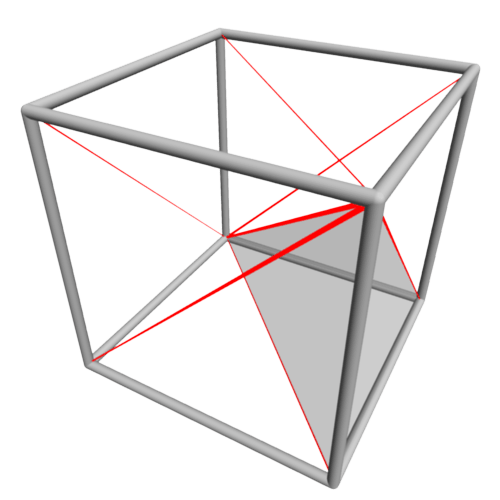
By own work - Own work, Public Domain, https://commons.wikimedia.org/w/index.php?curid=11978055j
i
k
If you're that geometric you could answer \(\approx \frac{n^3}{6}\).
How long with it run?
for i in 1 to 5
  for j in 1 to i
     for k in 1 to j
     // do something
Steps in a program can be estimated as volumes.
What on earth is the volume of that!?
You don't need to know the exact
j
i
k
Since \(1\leq k\leq j\leq i\leq n\).
- So you have \(n^3\) ways to choose \(i,j,k\) independently.
- You may need to sort them in order, 3 ways to move one, 2 ways to move a second, so divide by \(3\times 2\times 1=6\).
Rule 3
for i in 1 to 5
  for j in 1 to i
     for k in 1 to j
     // do something
Steps in a program can be estimated as volumes.
j
i
k
\sum_{i=1}^n\sum_{j=1}^i \sum_{k=1}^j 1=\frac{n^3}{3\cdot 2\cdot 1}+\text{ smaller digit terms }
Rule n
for i_1 in 1 to n
   for i_2 in 1 to i_1
      ...
        for i_k in 1 to i_(k-1)
		      // do something
\sum_{i_1=1}^n\cdots \sum_{i_k=1}^{i_{k-1}} 1=\frac{n^k}{k!}+\text{ smaller digit terms }
\(k!=k\cdot (k-1)\cdots 2\cdot 1\)
Asymptotics
By James Wilson
Asymptotics
How long will your program run? What will stand out in your data? Asymptotics can give us answers.