Future And Options


Long and short positions


Learning Outcome
5
Evaluate their role in hedging and price discovery.
4
Analyze risk and return.
3
Explain their use in market expectations.
2
Compare profit and loss outcomes.
1
Define long and short positions.
Long Position
A long position means you have bought an asset — or entered into a contract where you benefit when the price of that asset rises. You are the buyer. You profit when the price goes up and lose when the price goes down.
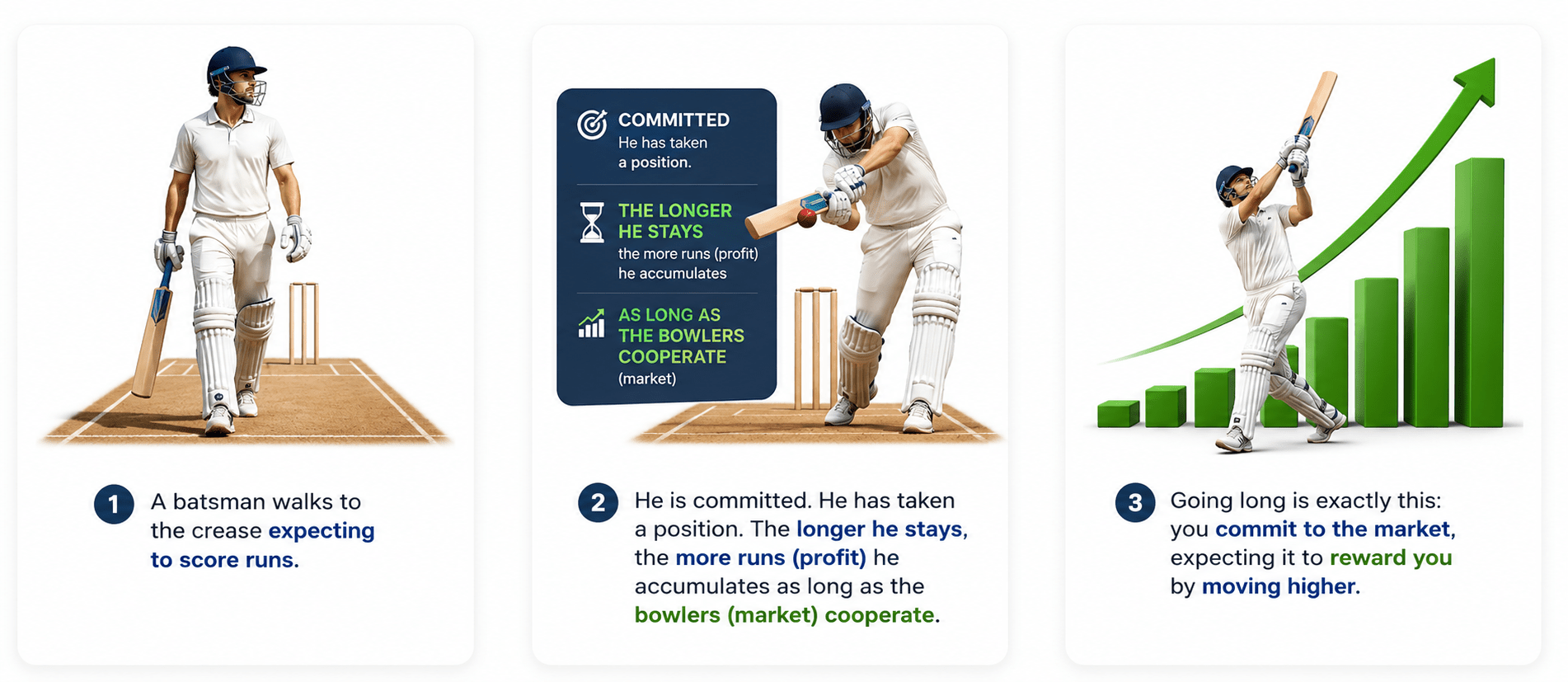
He is committed. He has taken a position. The longer he stays, the more runs (profit) he accumulates as long as the bowlers (market) cooperate.
Going long is exactly this: you commit to the market, expecting it to reward you by moving higher.
Cricket Analogy — The Batsman at the Crease
A batsman walks to the crease expecting to score runs.
How a Long Position Works — Step by Step (Futures)
STEP 1 : You identify an opportunity
You believe Reliance Industries will rise from its current price of ₹2,800 over the next month due to strong earnings expectations.
STEP 2 : You BUY a Reliance Futures contract
On NSE, 1 lot of Reliance futures = 250 units. You buy 1 lot at ₹2,800. Contract value = ₹2,800 × 250 = ₹7,00,000. Initial Margin (say 12%) = ₹84,000 deposited.
STEP 3: The market moves in your favour
Reliance rises to ₹2,950 before expiry. Your long position is now profitable.
STEP 4 : You CLOSE (SELL) the position
You sell the futures contract at ₹2,950 — the opposite transaction closes your position.
STEP 5 : Profit is booked
Profit = (₹2,950 − ₹2,800) × 250 = ₹150 × 250 = ₹37,500. Return on margin: ₹37,500 ÷ ₹84,000 = 44.6% gain on a 5.4% price move.
Profit & Loss Scenarios — Long Position
The table below shows all three possible scenarios when you hold a long position in Reliance Futures (entry: ₹2,800, lot size: 250):
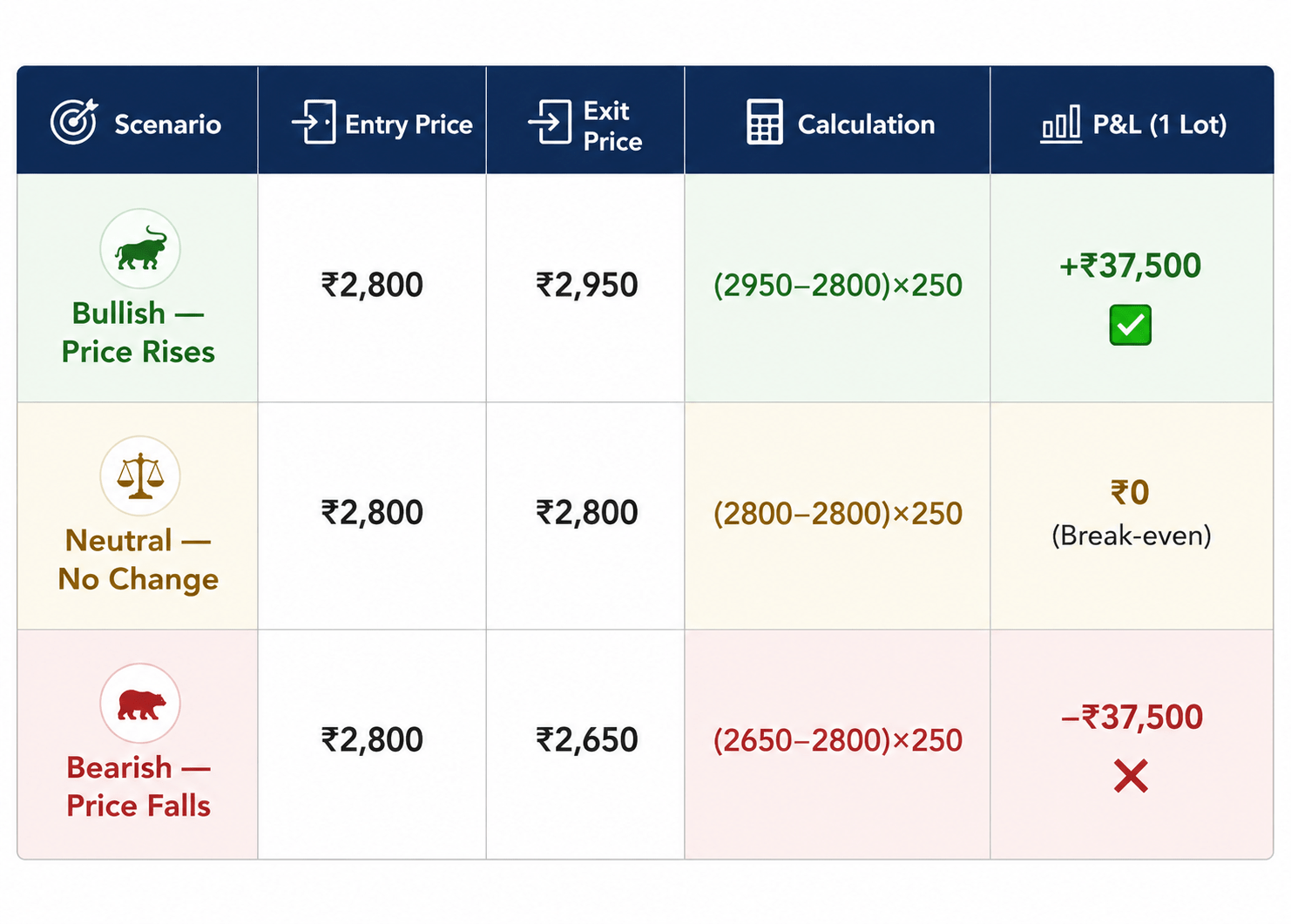
Key Rules for Long Positions
PROFIT when price RISES above entry.
LOSS when price FALLS below entry.
Maximum profit = theoretically unlimited (price can rise forever).
Maximum loss = entry price × lot size
(price can only fall to zero).
Visual: Long Position Payoff
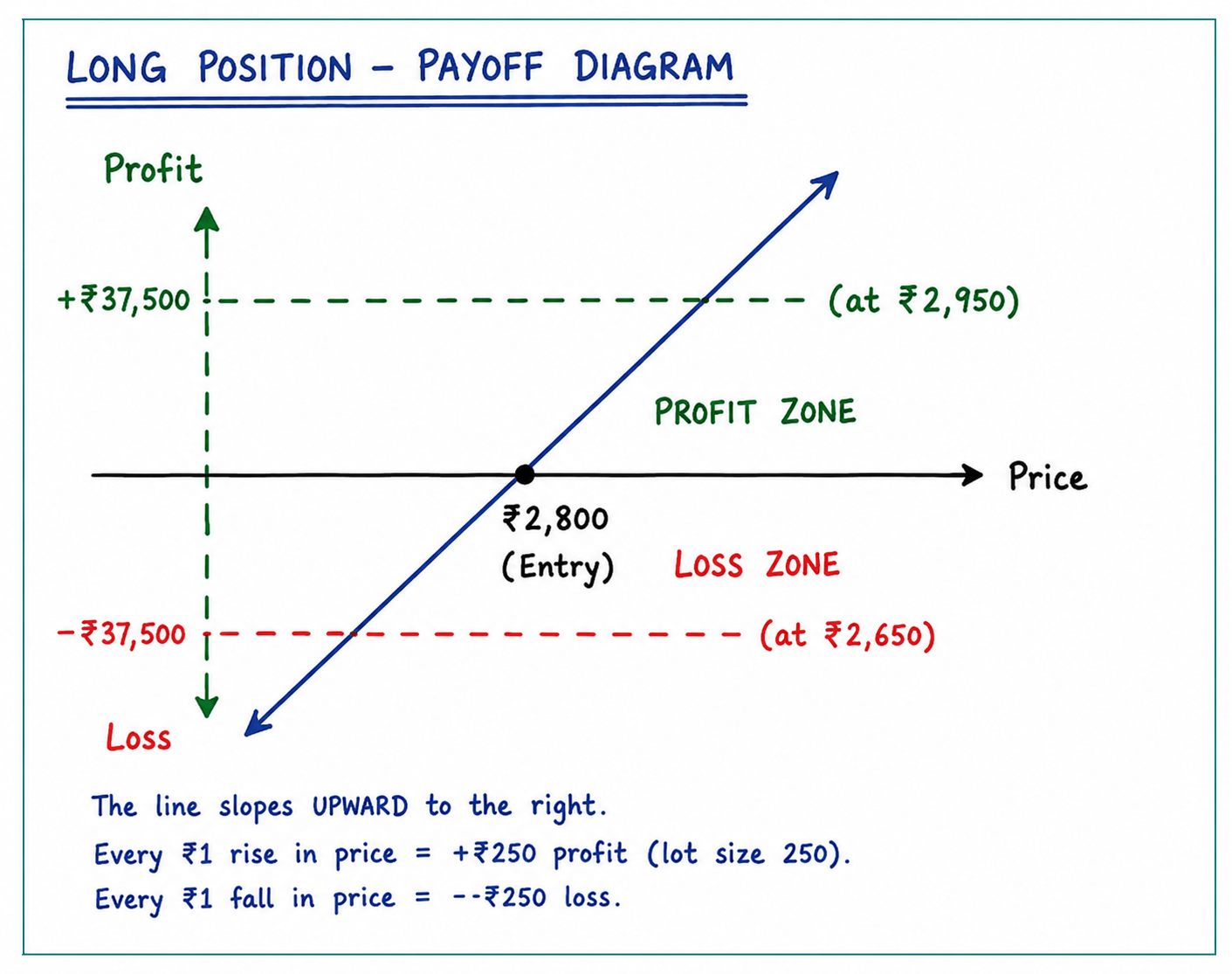
Indian Market Example — Infosys TCS Earnings Long Trade
Scenario: It is two weeks before TCS Q3 results. You believe results will beat expectations.
Action : Buy 1 lot TCS Futures at ₹3,700 (lot size: 150 units)
Contract val : ₹3,700 × 150 = ₹5,55,000
Initial margin: ~₹66,600 (12%)
Results day : TCS beats estimates. Price rises to ₹3,920.
P&L : (₹3,920 − ₹3,700) × 150 = ₹220 × 150 = ₹33,000 profit
Return on margin: 49.5% on a 5.9% price move — leverage at work.
Short Position
A short position means you have sold an asset you do not currently own — or entered into a contract where you benefit when the price of that asset falls. You are the seller. You profit when the price goes down and lose when the price goes up.
This is exactly how a short position works: sell first at today's high price, buy back later at a lower price.
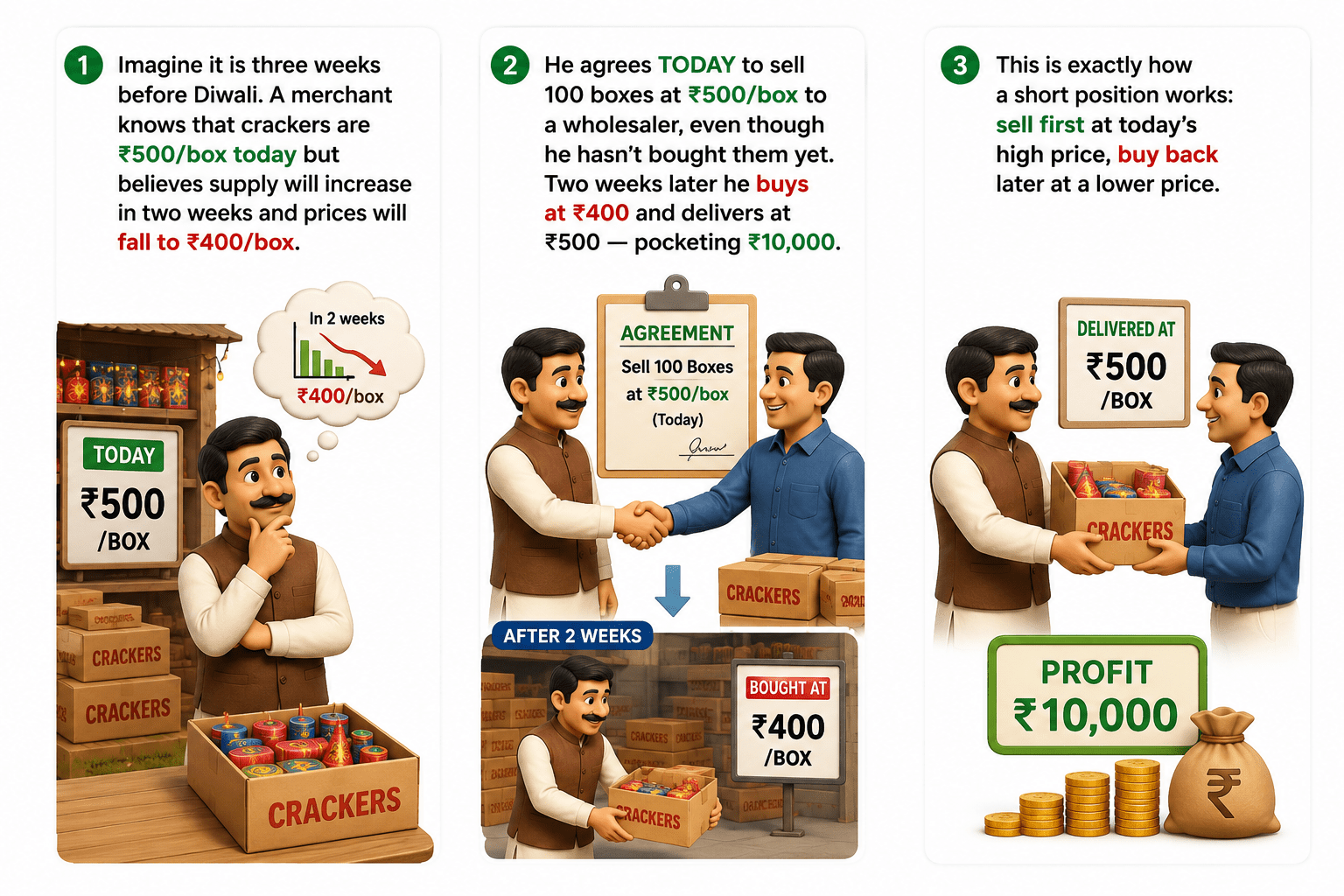
Imagine it is three weeks before Diwali. A merchant knows that crackers are ₹500/box today but believes supply will increase in two weeks and prices will fall to ₹400/box.
He agrees TODAY to sell 100 boxes at ₹500/box to a wholesaler, even though he hasn't bought them yet. Two weeks later he buys at ₹400 and delivers at ₹500 — pocketing ₹10,000.
Core Concepts (Slide 7)
Core Concepts (.....Slide N-3)
Summary
5
Build strong branding
4
Use different marketing channels
3
Target the right audience
2
Create and communicate value
1
Understand customer needs
Choose cool, soft colors instead of vibrant colors
Max 5 Points for Summary & Min 2
Quiz
Which platform is mainly used for professional networking and B2B marketing ?
A. Facebook
B. Instagram
C. LinkedIn
D. Snapchat

Quiz-Answer
Which platform is mainly used for professional networking and B2B marketing ?
A. Facebook
B. Instagram
C. LinkedIn
D. Snapchat