Repo and Securities Lending


Repo and Reverse Repo Rate


Learning Outcome
5
Trace the impact of Repo Rate changes on the economy.
4
Relate rates to loans, EMIs, and savings.
3
Understand their role in monetary policy.
2
Differentiate borrowing, lending, and applicable rates.
1
Define Repo and Reverse Repo.
What is Repo Rate?
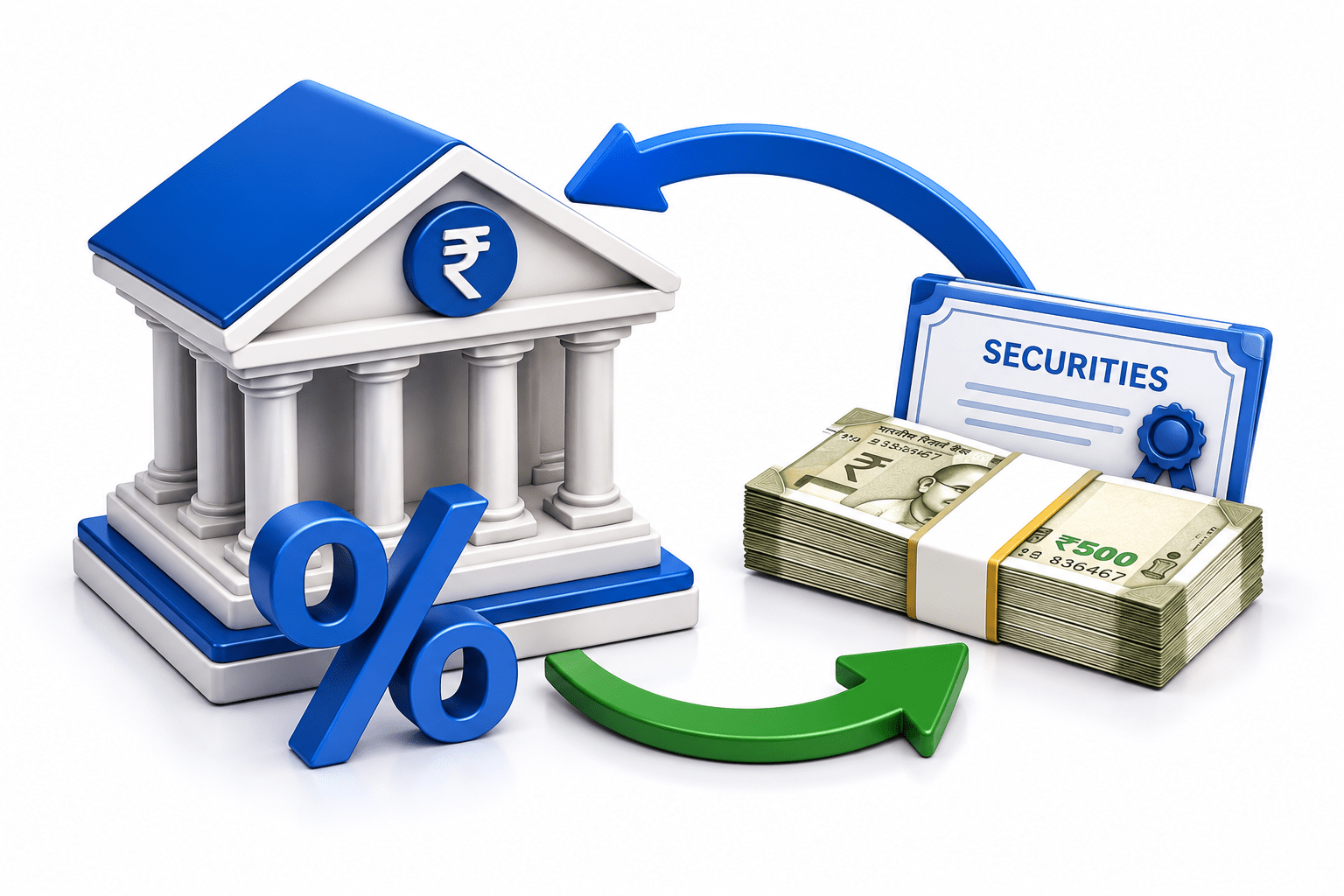
Repo Rate is the interest rate at which banks borrow funds from the RBI by pledging government securities as collateral.
Real-life link:
- When RBI raises the Repo Rate, banks pay more to borrow from RBI.
- Banks then charge you more on home loans and car loans.
- When RBI cuts the Repo Rate, your EMI goes down.
|
In short |
Repo Rate = The price banks pay to borrow cash from RBI overnight. Higher rate → Loans get expensive. Lower rate → Loans get cheaper. |
Step-by-Step: How a Repo Works (with Example)
- SBI needs ₹1,000 Crore overnight to meet its daily cash requirements.
- SBI goes to the RBI's LAF (Liquidity Adjustment Facility) window.
- SBI temporarily gives Govt Securities worth ₹1,000 Cr to the RBI.
- RBI gives SBI ₹1,000 Cr cash immediately.
- Next day: SBI returns ₹1,000 Cr + interest (₹14.38 Lakh) at 5.25% Repo Rate.
- RBI returns the Govt Securities to SBI. Deal closed.
Quick Math
Loan Amount: ₹1,000 Crore
Repo Rate: 5.25% per annum
Duration: 1 day (overnight)
Interest = ₹1000 Cr × 5.25% ÷ 365 = ₹14.38 Lakh
SBI pays ₹14.38 Lakh to RBI as borrowing cost.
What is Reverse Repo Rate?
Reverse Repo Rate is the interest rate the RBI pays banks for depositing excess funds with it for a short period.

Real-life link:
When RBI raises the Reverse Repo Rate, banks find it more attractive to park money with RBI rather than lend it out.
Less lending → less money circulating → inflation cools down.
In short
Reverse Repo Rate = The return a bank earns when it deposits surplus cash with RBI.
Higher rate → Banks prefer to park money with RBI. Less lending in the market.
Step-by-Step: How a Reverse Repo Works (with Example)
-
HDFC Bank has ₹500 Crore surplus cash at the end of the day — more than it needs.
-
HDFC deposits this ₹500 Cr with the RBI through the Reverse Repo window.
-
RBI gives HDFC Govt Securities as collateral (safety deposit).
-
Next day: RBI returns ₹500 Cr + interest (₹4.59 Lakh) at 3.35% Reverse Repo Rate.
-
HDFC returns the Govt Securities. Deal closed.
-
Zero risk — because the counterparty is the RBI itself.
Quick Math
Deposit Amount: ₹500 Crore
Reverse Repo Rate: 3.35% per annum
Duration: 1 day (overnight)
Interest = ₹500 Cr × 3.35% ÷ 365 = ₹4.59 Lakh
HDFC earns this ₹4.59 Lakh from RBI — completely risk-free.
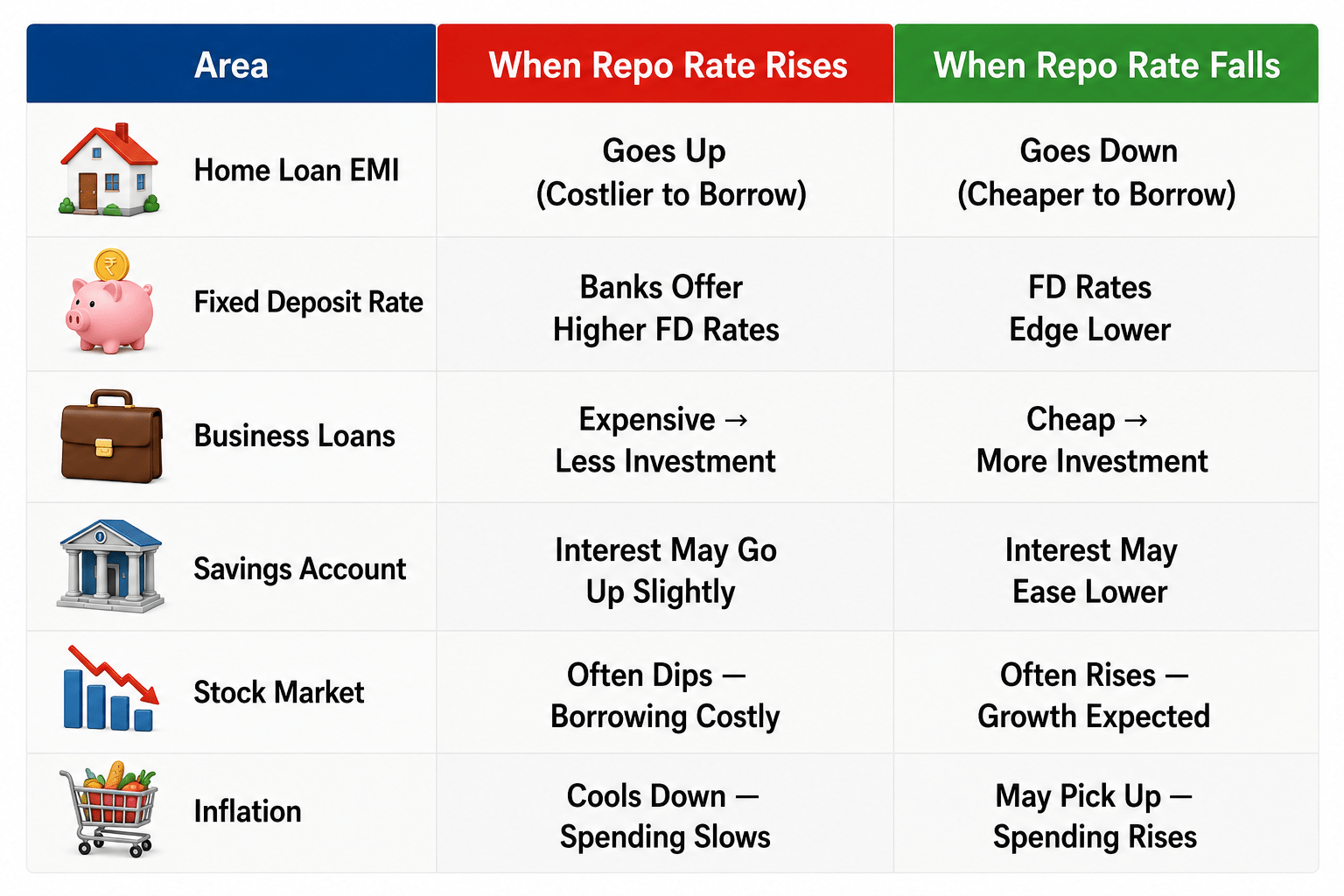
Real Impact on Banks and Customers
Summary
5
RBI uses both to manage liquidity and inflation.
4
Higher Reverse Repo = More funds parked with RBI.
3
Higher Repo = Costlier loans.
2
Reverse Repo Rate: Rate banks earn from RBI deposits.
1
Repo Rate: Rate at which banks borrow from RBI.
Quiz
Repo Rate is the rate at which:
A. Customers borrow from banks
B. Banks borrow from RBI
C. RBI borrows from banks
D. Companies borrow from banks

Quiz-Answer
Repo Rate is the rate at which:
A. Customers borrow from banks
B. Banks borrow from RBI
C. RBI borrows from banks
D. Companies borrow from banks